
Google Changes Search for the First Time in 25 Years
AI Inside for Wednesday, May 20, 2026

I was at Google I/O this week in person. It was a lot. Like, a genuinely packed IO. The New York Times ran a piece this week titled “How Google Is Starting to Win the A.I. Race” and honestly, after being there, with the scope of everything, I tend to agree. They continue to leverage the sheer network effect of their entire portfolio of projects. As I said many times at the show, they are continuing to bring “everything to everything.” You can check out the full episode now.
But first, a big thank you to this week’s Patrons of the Week: captincaveman, counterpoint, Michael Reichart, Lisa Edwards, and Ryan Lounsbury. You all joined since the new AI Inside Daily podcast began for Patrons, WELCOME!
NOTE: Every Friday episode of the new AI Inside Daily podcast will be released for FREE to Patrons going forward!
Be sure to sign up so you don’t miss an extra podcast every single week! Head to patreon.com/aiinsideshow.
Let’s Start with the Models
Gemini 3.5 Flash was the foundation. Google’s framing: “frontier intelligence with action,” built specifically for agentic workflows, not just answering questions. What stood out to me: it outperforms Gemini 3.1 Pro on coding and agentic benchmarks, and it’s 4x faster than other frontier models at a similar level. Available today in the Gemini app, AI Mode in Search, the Gemini API, and Google’s Antigravity framework, which is their agentic development platform. Gemini 3.5 Pro is coming next month, being used internally now.
And then there’s Gemini Omni. This is the multimodal model: any input, any output, including video generation. Improved physics, more consistent character rendering across shots. DeepMind CTO Koray Kavukcuoglu called it “one step closer to a true world model.” Yann LeCun’s been saying for years that LLM scaling won’t get us to real-world models. Be curious what he makes of this claim. Omni Flash is out today for AI Plus, Pro, and Ultra subscribers, and it’s flowing into Google Flow and YouTube Shorts.
Google is also requiring SynthID watermarking on all video generations going forward, and a small coalition is forming around it. OpenAI, Kakao, Nvidia, and ElevenLabs are all joining SynthID. Getting multiple competitors to agree on anything is harder than it sounds.
Search: The Biggest Upgrade in 25 Years
Google called this the biggest upgrade to the Search box in over 25 years. AI Mode, which launched last year, has now surpassed 1 billion monthly users. Queries more than doubled every quarter since launch, and last quarter hit an all-time high. So Google believes people are searching MORE because of AI Mode, not less.
Here’s what changed this week. Three layers.
Layer one is the search box itself. It now dynamically expands to give you more space to describe what you need, and it helps you formulate your query with AI-powered suggestions that go beyond autocomplete. Although let’s be real: even though they literally said on stage “this isn’t autocomplete”... it really is, at its core. Also multimodal now: text, images, files, videos, Chrome tabs as input. Rolling out today globally, everywhere AI Mode is available.
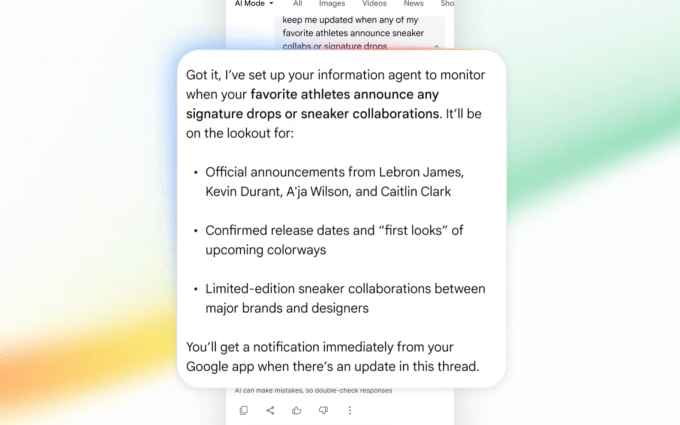
Layer two: Search Agents, specifically Information Agents. These run 24/7 in the background, intelligently monitoring whatever you tell them to watch. Blogs, news sites, social posts, real-time finance data, shopping, sports. Whatever you care about. The example that clicked for me: apartment hunting. You describe exactly what you need, the agent scans for you 24/7, and notifies you when listings match. Or sneaker drop monitoring, biotech stock triggers. Anything where the timing matters and you don’t want to check manually. Launching first for Google AI Pro and Ultra subscribers this summer.
Layer three: Agentic coding inside Search. Fire off a query, and instead of a static list of links or even an AI overview, Search can now build you a custom dynamic response on the fly. Custom layouts, interactive widgets, tables, graphs, simulations, all generated for your specific question, all interactive. You can iterate with follow-ups. Under the hood: Google’s Antigravity framework powers the agentic coding layer, 3.5 Flash handles the steps. Rolling out this summer. More coming after that: dashboard capabilities, mini apps for long-running tasks like planning a move or managing a health routine.
The question I keep coming back to is whether users actually WANT their search to change this fundamentally. Search has always been predictable. That predictability is part of what makes it trustworthy. Also, will the presence of “app creation inside search” scare normies? Will it be presented in a way that’s less nerdy and more for everyday users to discover new solutions to the things they use search for? It also occurred to me that the agents inside Search are analogous to the agents inside smartphones and the bypassing of apps to carry out tasks for users. A lot of change is on the horizon.
Gemini Spark
This one I’m super interested in because it addresses something I run into every single day with Claude Cowork.
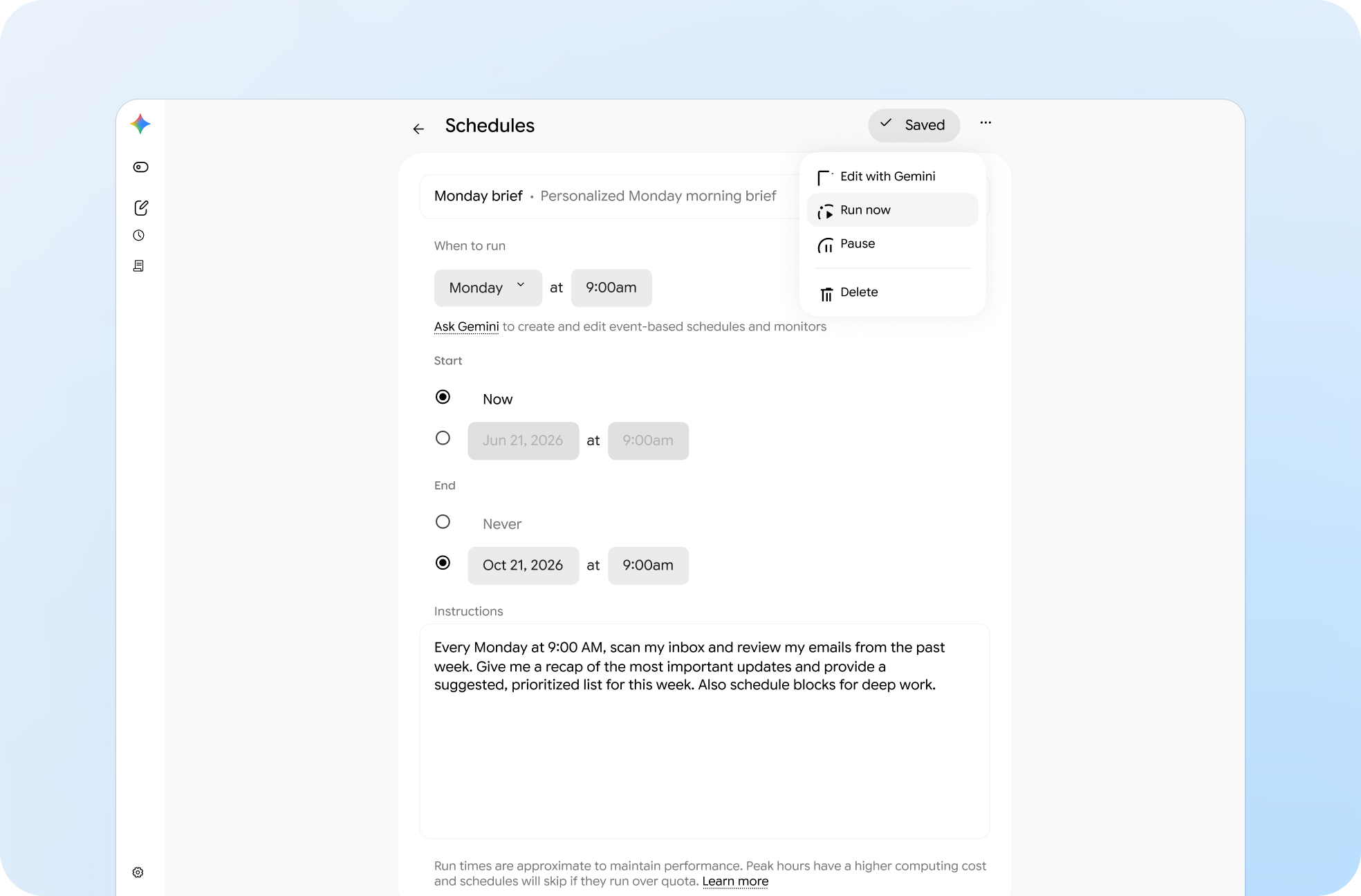
Gemini Spark is Google’s 24/7 personal AI agent. It runs in the background, takes action on your behalf, under your direction. But it runs on Google’s dedicated cloud machines, NOT your laptop or desktop. I walk around with a half-open laptop sometimes to keep agentic tasks from shutting down. I am guilty of this. Having an agent running in the cloud means you fire it off from any machine, close the lid, and it keeps going. Something I run into with Cowork constantly is the lack of portability between machines. A lot of the work is tied to the specific machine it’s running on. Spark addresses that directly.
Rolling out to trusted testers today, Beta hitting Google AI Ultra subscribers in the US next week. Integrates with MCP (the open standard for connecting AI to external tools) and Google’s own products. Coming to Chrome directly as well. Android Halo is the phone-native companion, with dedicated agents on your Android device, later this year. Power users can build their own workflows this summer.
Universal Cart
Universal Cart is Google’s agentic play for shopping. A cart that follows you across Search, the Gemini app, YouTube, and Gmail. Add products from anywhere across Google. The cart tracks deals, monitors price drops, surfaces price history, and alerts you when items are back in stock. And it can flag compatibility issues. The example: you’re building a custom PC, you add parts from multiple merchants, Google flags when a processor doesn’t work with the motherboard you picked, and suggests an alternative.
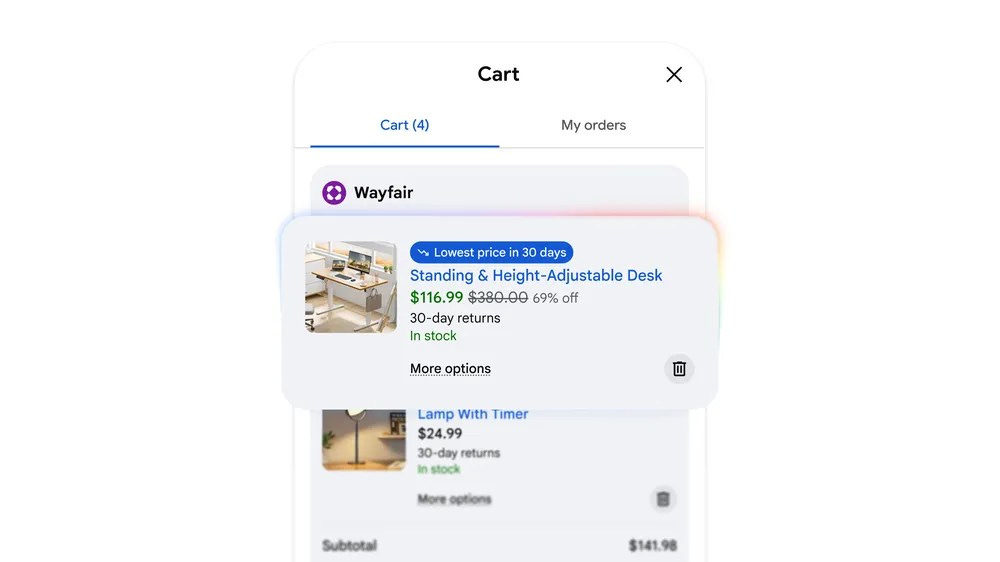
Works with Google Wallet to surface hidden loyalty discounts. Powered by Google’s Universal Commerce Protocol. Partners already on board: Amazon, Meta, Microsoft, Salesforce, Stripe. The more interesting part is AP2, the Agent Payments Protocol. You set rules: the brands you want, a spending limit. When conditions are met, the agent makes the purchase automatically. Google is bringing AP2 to its own products in the coming months. Universal Cart is rolling out in the US today.
Worth noting: this gives Google direct visibility into what you discover, consider, and ultimately buy across its entire ecosystem. Retailers and payment processors are watching this closely.
AI Design and Creativity Tools
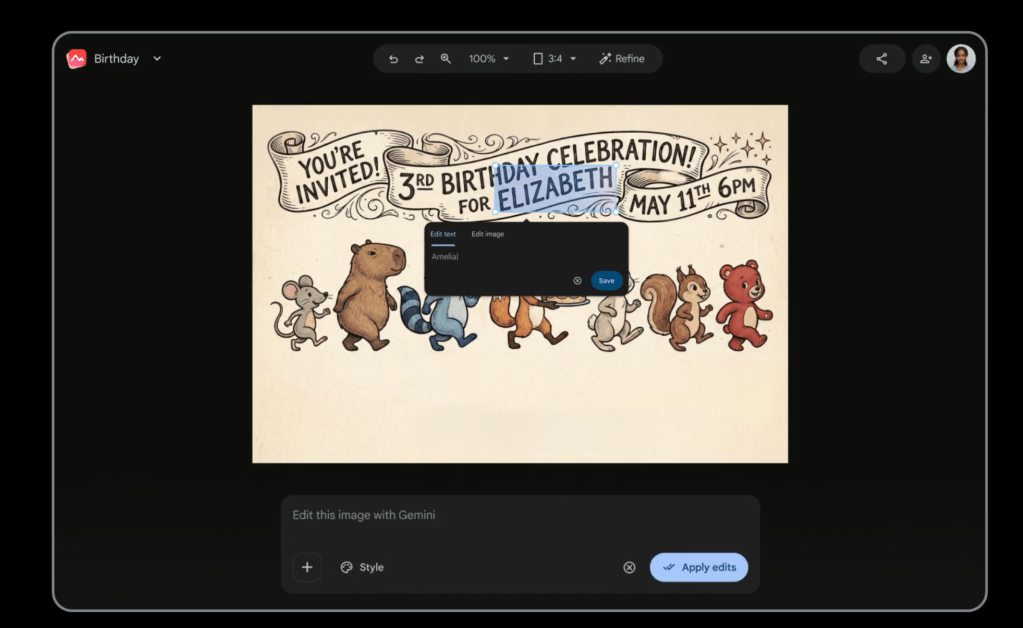
On the creativity side, Google just declared itself a contender in AI design. Google Pics is a new image creation and editing tool in Workspace for fliers, infographics, and that kind of work. SynthID built in. Coming to Pro and Ultra users this summer. Stitch, Google’s UI design tool, got updates with voice collaboration in real time. Available today.
Google Flow, which launched last year at IO, got a significant update: Omni for visual consistency across shots, a new multi-action agent so you can say “find the best camera angles for this scene” as a single command, and collaborative music production. Share a piano lick, it turns it into a production concept. Available today for paid tiers. And Omni is flowing into YouTube Shorts creation, which means AI-generated video at scale is getting even more accessible.
Audio Glasses, a Long Time Coming
Google is finally announcing details of its consumer Audio Glasses in partnership with Warby Parker and Gentle Monster. These do NOT have a display. Essentially, Google’s version of Meta Ray-Bans, running Gemini on board. I’ve tested these multiple times over the past few years on development hardware, including at the show yesterday, and Gemini is MORE useful to me on these than Meta AI is on the Ray-Bans. Because Google has all of my personal context. It knows my calendar, my location history, my habits. Gemini on glasses that understand you is genuinely different.
Two styles at launch, more designs coming this fall. Samsung is also building its own pair that works on Google’s platform. And these will pair with both Android and iOS, which is a bigger deal than it sounds. Display models, monocular and binocular, also exist. I tried them at IO. Both were incredibly sharp and effective. Google says more details on those later this year.
That said, I did get the vibe from friends there that were confused why it’s taken this long for Google to catch up with the Meta Ray-Bans.
Genie World Models
I got to demo Genie World Models on the IO floor. I picked an environment (I created my own: podcast studio) and a character (I picked the spinning top). After 60 seconds, it presented the experience to me, and I could control it with two joysticks and a jump button. The model was a little slow, but still VERY intriguing to see it done in real time.
Also from I/O
Worth a quick mention from the stage: Demis Hassabis presented Gemini for Science and a Code Security Scanner, with a focus on responsible AI development. And ZDNet did a piece on the increasingly complex Google AI subscription lineup. If you have questions about which plan to choose at this point, you are not alone. It’s getting genuinely hard to track.
Andrej Karpathy Is Joining Anthropic
Andrej Karpathy is joining Anthropic. Karpathy is one of the most respected AI researchers working today: a founding member of OpenAI, former director of AI at Tesla, where he led the computer vision team behind Autopilot. He coined the term “vibe coding.” He left Tesla in 2022, built an AI education startup called Eureka Labs, and this week he announced he’s joining Anthropic’s pre-training team. His specific focus: using Claude itself to accelerate pretraining research, basically having the model help improve itself.
His quote from X: “I think the next few years at the frontier of LLMs will be especially formative. I am very excited to join the team here and get back to R&D.” He also said he remains passionate about education and plans to return to that work “in time.”
This is a significant hire. The talent war in AI is real, and Anthropic continues to pull in people who could go anywhere.
Anthropic Acquires Stainless
Anthropic also acquired Stainless this week. Stainless is a New York startup founded in 2022 by Alex Rattray, a former Stripe engineer. Stainless was being used by OpenAI, Google, Cloudflare, Runway, Replicate. All of them Anthropic’s direct competitors. And Anthropic just acquired it, for a reported $300 million plus. They’re winding down all hosted Stainless products. Competitors keep the SDKs they already generated, but they lose access going forward.
What does Stainless do? They automate the creation and maintenance of software development kits: the libraries developers use to connect to APIs. Rattray built software that takes API specifications and turns them into production-ready SDKs across Python, TypeScript, Kotlin, Go, Java, and more, and it automatically updates those SDKs as the APIs change, which was the pain point. Anthropic says Stainless has powered every official Anthropic SDK since the earliest days of their API.
So this is Anthropic pulling a key piece of shared infrastructure out of the commons and locking it down. Competitors will have to build or find alternatives.
I Used Claude Design for the New Podcast Art
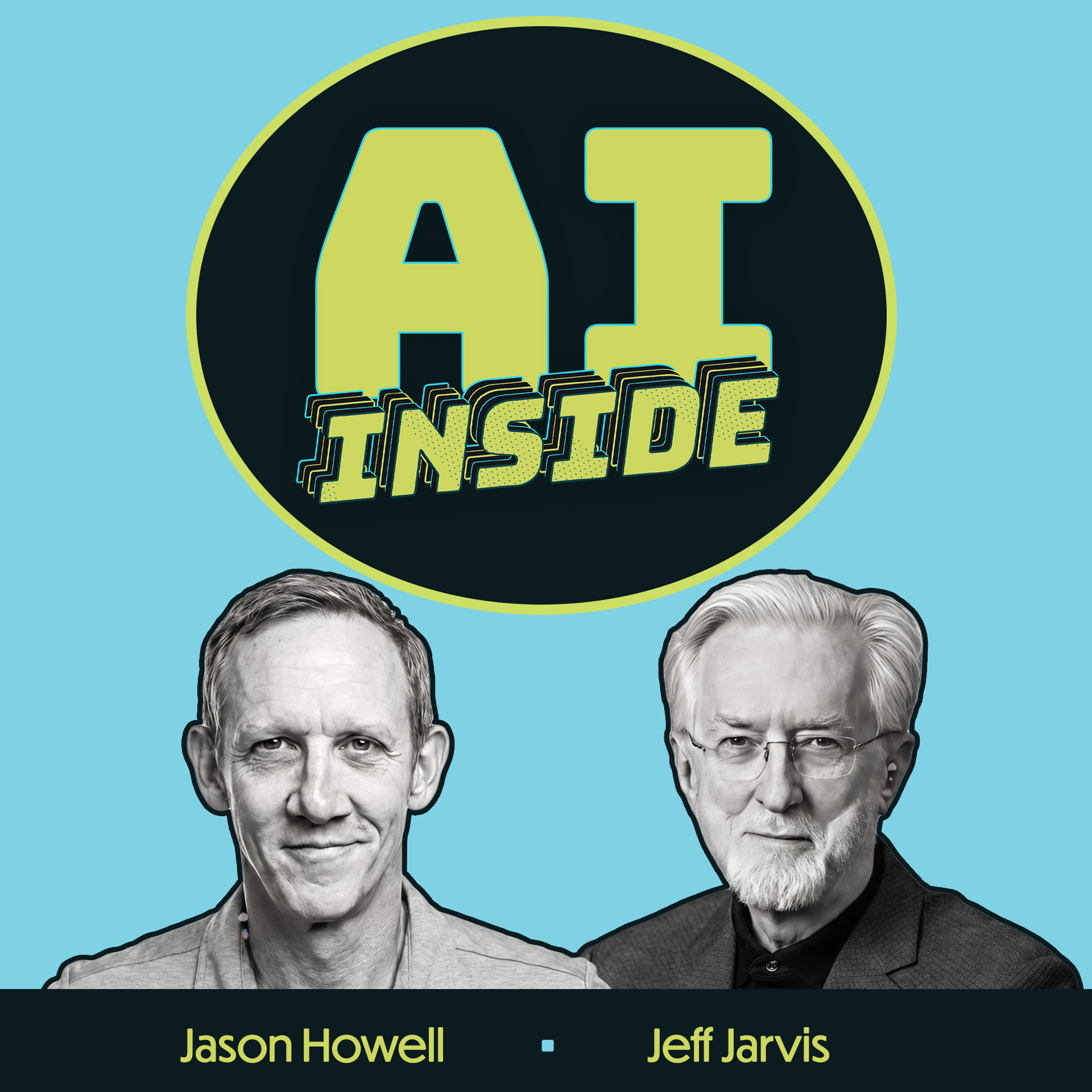
By the way, I used Claude Design for the first time last week when I wanted to start ideating around podcast art redesign. It was sort of hilarious, the results I got out of it. The images themselves, the fresh ideas it shared, look pretty horrible in themselves. But it still gave me directional points to explore, and I can absolutely say that it led me toward the idea of the final art. I also leaned into the opinions of Patrons. Thank you, Patrons! I LOVE the new podcast art.
Amazon Alexa+ Can Now Generate Podcast Episodes
Amazon’s new Alexa+ powered feature can generate podcast episodes, called “Alexa Podcasts.” Rolling out to US customers today. You ask Alexa+ to create a podcast about a topic, it researches it, gives you a summary of what the episode will cover, you can tweak length, tone, and focus, then it generates it with AI voices. Episodes get saved and can be replayed in the app. Amazon emphasized reliability by naming news partnerships: the Associated Press, Reuters, Washington Post, Time, Forbes, Business Insider, Politico, USA Today, and more than 200 local newspapers.
Can it do this? Yes. Whether there’s an audience for AI-narrated audio content is a genuinely different question. And the accuracy issue on complex or news topics is not a small one. Name-dropping the AP doesn’t fully solve the problem of an AI model interpreting and presenting that content. But we shall see!
Elon Musk and the OpenAI Lawsuit
The Wall Street Journal had a piece this week on the art of losing a lawsuit and still claiming victory, Elon Musk edition. Musk lost. The case was dismissed. But his team and public statements framed it as a win, arguing the lawsuit itself surfaced damaging information about OpenAI’s nonprofit-to-profit conversion. Essentially, Musk is redefining the victory conditions after the outcome. Whether this actually damaged OpenAI’s reputation or just generated headlines is a real question worth asking. Not much more to say about this one, honestly.
The American Rebellion Against AI
The WSJ had a piece this week on what it called “The American Rebellion Against AI.” A growing backlash that is tangible. The piece documents people opting out, pushing back, organizing around fatigue with AI-generated content and fear about what it’s displacing. What’s driving it: job anxiety, hatred of AI slop, distrust of the companies building it, and a sense that the pace of change isn’t leaving room for consent. Is this a cultural moment? Is it the beginning of a structural shift?
And related to this, Eric Schmidt got booed at the University of Arizona commencement. Students were not having it when Schmidt spoke about AI during his speech. They booed LOUDLY. Schmidt has been one of the more aggressive advocates for AI investment and national AI competition. Worth watching where this goes.
Speed Round
NextEra to Acquire Dominion
NextEra Energy is acquiring Dominion Energy in a deal that unites two of the most important players in powering AI data centers. AI data centers are consuming electricity at a scale that is straining the grid in ways that existing utility companies weren’t built to handle. A deal like this is about positioning for a future where whoever controls the power supply for AI compute has significant leverage.
Pope Leo XIV’s AI Encyclical
Pope Leo XIV will publish his first encyclical, Magnifica Humanitas, on May 25th. It’s expected to address AI and humanity directly. And Anthropic co-founder Christopher Olah will join the launch panel at the Vatican. That an Anthropic founder is sitting on that panel is worth noting. It signals something about how Anthropic positions itself in the ethics and values conversation.
Linus Torvalds on AI Bug Hunters
Linus Torvalds says AI-powered bug hunters have made the Linux security mailing list “almost entirely unmanageable.” Multiple researchers are using the same AI tools to find the same bugs and then flooding the list with duplicate reports. His words: “enormous duplication due to different people finding the same things with the same tools,” creating what he called “unnecessary pain and pointless make-believe work.” His guidance to AI bug hunters: “If you actually want to add value, read the documentation, create a patch too, and add some real value on top of what the AI did.”
Meta Ray-Ban Display Glasses
Meta is bringing virtual writing to everyone with Meta Ray-Ban Display glasses. Neural handwriting apps are now coming to the display glasses, expanding developer capabilities. Interesting timing right after Google’s audio glasses announcement at IO.
xAI’s Grok Build Coding Agent
Musk’s xAI unveiled Grok Build, its first coding agent, working to close the gap between Grok and the coding capabilities of Claude and OpenAI. Claude Code and similar developer-focused tools have built real traction with developers. Whether xAI can catch up in an area where Anthropic has a meaningful lead is the question.
OpenAI IPO
Right before showtime, the WSJ published an exclusive report that OpenAI is preparing an IPO filing as early as this Friday. So buckle up!
A huge thank you to our Executive Producers: DrDew, Jeffrey Marraccini, Radio Asheville 103.7, Dante St James, Bono De Rick, Jason Neiffer, Jason Brady, Anthony Downs, Mark Starcher, and Karsten Samaschke. Your support at the top tier makes AI Inside possible week after week.
Thank you so much for watching and reading. Find every episode at aiinside.show, and if you want to support the show, head to patreon.com/aiinsideshow.