
AI Inside: Benchmarks for Mortals
For Wednesday, March 26, 2025

Just like every new AI model release, we have proclaimed that this episode is “the best episode yet!” We hope you agree. But before you judge for yourself:
A HUGE thank you to those supporting us directly via Patreon at patreon.com/aiinsideshow, like Neal Wood!🎉
Be sure to subscribe to the podcast so you don't miss future episodes. Find all the details at aiinside.show.
OpenAI's ChatGPT-4o: Text in AI Image Generation Levels Up
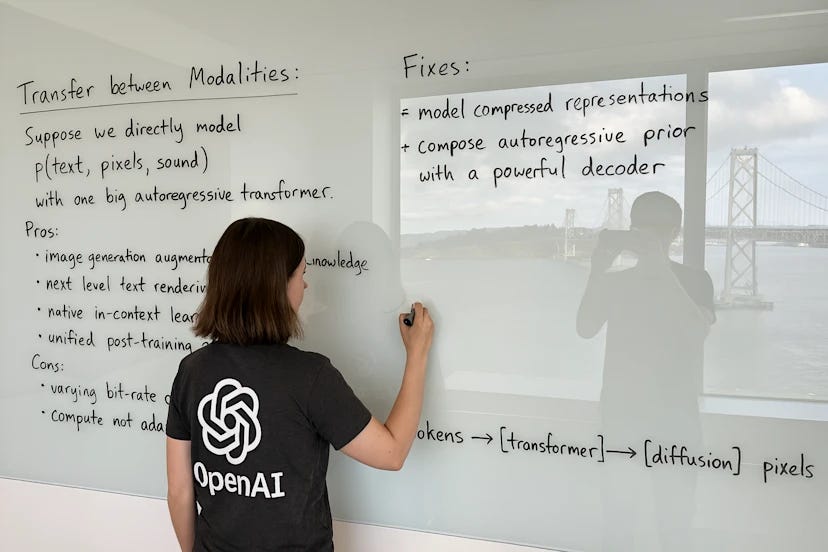
OpenAI released an update to ChatGPT-4o yesterday, touting it as their "most advanced image generator." The system was trained with the relationship of images and text as a key component, resulting in better consistency, improved context awareness, and more complexity in its rendering. It can now handle 10-20 different objects (compared to 5-8 as the previous limit) and boasts highly accurate text rendering. Interestingly, GPT-4o has even solved the "wine glass" problem in AI rendering, where previous models struggled to generate images of full wine glasses due to training data limitations.
Google's Gemini 2.5 Pro: Smarter, Faster, Better at Reasoning
Google has released Gemini 2.5 Pro, claiming it's their "most intelligent AI model." It's reportedly smarter, faster, and better at reasoning, beating OpenAI's GPT-4.5 and Deepseek in the LMArena leaderboard. The model excels in coding, particularly web app development and code transformation tasks. It launches with a 1 million token context window, with plans to expand to 2 million tokens. Google shared an impressive video demonstrating the creation of an endless runner game based on a single prompt.
OpenAI's Research on Chatbot Interactions and Emotional Impact
OpenAI, in collaboration with MIT Media Lab, conducted two studies involving 40 million interactions and 4,076 users to understand how interacting with chatbots impacts users emotionally. While most users treat ChatGPT as a productivity tool, a subset engaged emotionally, showing higher levels of loneliness and dependency. Interestingly, voice interactions initially lessened emotional dependency but elevated these effects when users chose a voice of the opposite gender.
The Atlantic's LibGen Database Search Tool
The Atlantic has released a tool allowing anyone to run keyword searches on the LibGen database, the same database used by Meta to train its AI systems. This searchable tool is a snapshot from January 2025 and is related to court documents in the case brought by Sarah Silverman and others. The court documents reveal that the dataset was at least partially filled through Bittorrent file sharing methods, raising questions about copyright and fair use.
AI Web Crawlers Overwhelming Open Source Software Community
AI web crawlers are causing significant disruptions in the open source software community, leading to service disruptions and increased costs. These bots account for 97% of traffic on some projects and can bypass standard blocking measures. Some projects are implementing extreme solutions, including closing off access to entire countries and using "tarpits" to trap and waste crawler resources. This situation reflects a broader trend where the need for high-quality data conflicts with sustainable data collection methods.
Perplexity's Bid for TikTok
Perplexity is making a bold move to buy TikTok, pitching a vision of "Rebuilding TikTok in America." Their plans include rebuilding the algorithm, adding Community Notes, open-sourcing the For You feed, and integrating TikTok's short-form videos into their search engine. However, Perplexity faces stiff competition from a ByteDance/Oracle deal. The temporary Executive Order protecting TikTok from a ban expires on April 5, with President Trump signaling a likely extension if needed.
Richard Sutton on AI and AGI
In an interview with Die Zeit, Turing Award winner Richard Sutton shared his thoughts on AI and AGI. He believes that current language models are insufficient for achieving AGI without reinforcement learning. Sutton also addressed fears surrounding AI, comparing potential job losses to those during the industrial revolution and suggesting that AI could lead to the decentralization of power rather than its concentration.
AI-Powered Visual Dubbing in Cinema
The Swedish sci-fi film "Watch the Skies" will debut in AMC theaters on May 9 with "visual dubbing" for its US release. This AI-powered technology, called TrueSync by Flawless, aligns actors' mouth movements with the dubbed dialogue. While this solves the lip-sync issue, questions remain about preserving the emotional context of acting and how the technology will hold up over a full-length feature on the big screen.
Thank you to our Executive Producers on Patreon: DrDew, Jeffrey Marraccini, WPVM 103.7 in Asheville NC, Dante St James, Bono De Rick, Jason Neiffer, and Jason Brady!
See you next Wednesday!